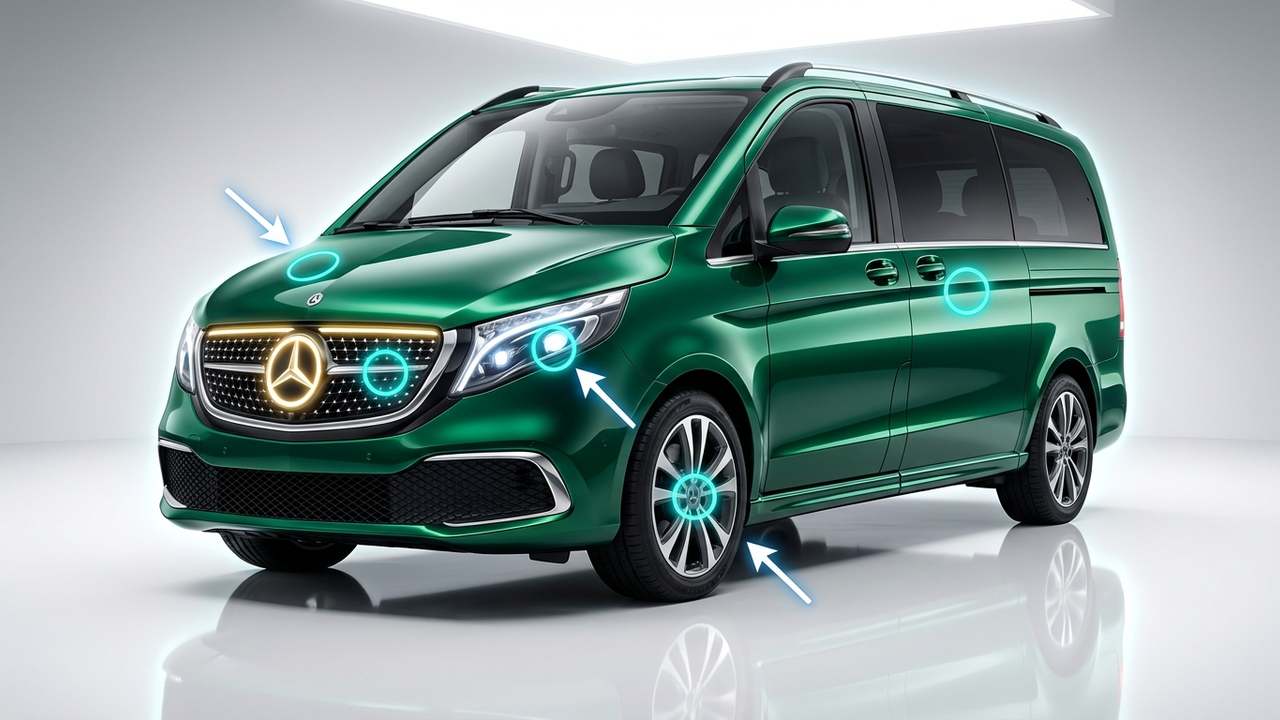
The 2026 Mercedes-Benz V-Class Unveiled across the USA represents a significant turning point for luxury people-movers in America. Mercedes has taken the familiar function of the V-Class van and reimagined it as a full-electric offering aimed squarely at families, shuttle services, and boutique fleet operators. The shift to an all-electric architecture promises quieter cabins, a lower total cost of ownership for many U.S. buyers, and the brand polish Mercedes-Benz customers expect.
2026 Mercedes-Benz V-Class Unveiled across the USA: What this all-electric pivot means
Mercedes has positioned this model as more than a replacement — the 2026 Mercedes-Benz V-Class Unveiled across the USA is a redefinition of the van segment. The company has blended traditional V-Class strengths — configurable seating, cargo flexibility, and premium materials — with EV technology, resulting in a product that aims to please both private buyers and commercial operators.
For American consumers, this shift signals broader acceptance of electric vans in daily life, from family road trips to airport shuttle duties. Expect improvements in cabin refinement, reduced drivetrain maintenance compared with ICE vans, and a focus on usable range and charging convenience rather than headline horsepower figures.
2026 Mercedes-Benz V-Class Unveiled across the USA: Design, space and cabin comfort
The design language of the 2026 Mercedes-Benz V-Class Unveiled across the USA leans on Mercedes-Benz’s luxury cues without losing the practical silhouette that defines a van. The cabin emphasizes modular seating and thoughtful storage solutions. Second- and third-row seats are engineered for quick reconfiguration, allowing owners to switch between seven-passenger comfort and generous cargo-hauling in minutes.
Materials and fit-and-finish reflect Mercedes’ brand promise. Soft-touch surfaces, optional multicontour seats, and a more driver-focused dash give the V-Class a premium living-room vibe. Climate control systems are tuned for U.S. climates — from humid Gulf Coast summers to cold Northeastern winters — and rear climate zoning is standard or optional depending on trim.
2026 Mercedes-Benz V-Class Unveiled across the USA: Practical interior features
Expect features tailored to American buyers: multiple USB-C outlets, built-in 120V power points, and easy-to-clean upholstery options. The V-Class’s configurations cater to different use cases — families who need child-seat anchors and entertainment provisions, and fleet operators who value durable flooring and easy ingress/egress for passengers with luggage.
The modular floor plan also supports accessory packages popular in the U.S., such as roof-storage preparations, tow packages (where applicable), and privacy glass options for executive shuttle services.
2026 Mercedes-Benz V-Class Unveiled across the USA: Powertrain, range and real-world driving
The 2026 Mercedes-Benz V-Class Unveiled across the USA comes as a dedicated electric vehicle platform, which improves interior packaging and lowers the center of gravity versus ICE predecessors. Mercedes is offering multiple battery and motor configurations to match different buyer needs — higher-capacity batteries for longer-range family travel and smaller packs for urban shuttle duties.
In practical terms, U.S. drivers should expect EPA-ish range estimates that support typical American driving patterns: daily commutes, weekend getaways, and occasional long-distance trips. Mercedes is prioritizing sustained highway efficiency and thermal management systems so motorists see consistent range in hot summers and cold winters.
2026 Mercedes-Benz V-Class Unveiled across the USA: Driving impressions
Early impressions from test drives indicate smooth, linear acceleration characteristic of electric motors and a hushed cabin ideal for long trips. Regenerative braking is calibrated for a comfortable one-pedal feel in city driving, while suspension tuning balances ride comfort and body control when loaded with passengers or cargo.
For American drivers who tow occasionally, check factory towing limits and optional equipment. EV towing can materially affect range, so plan routes with charging opportunities if you intend to tow regularly.
2026 Mercedes-Benz V-Class Unveiled across the USA: Charging, infrastructure and U.S. incentives
Charging is a central part of ownership calculus. The 2026 Mercedes-Benz V-Class Unveiled across the USA supports Level 2 AC charging for overnight replenishment and DC fast charging for highway top-ups. Mercedes will partner with public charging networks to provide convenient access and possibly integrated charging plans in the U.S.
American buyers should evaluate total charging costs and convenience. Many households will choose a home Level 2 charger; installation costs vary by state and home electrical setup. Local utilities sometimes offer rebates for charger installation and time-of-use rates that reduce charging costs for overnight sessions.
In terms of incentives, federal and state programs change over time. Buyers in the U.S. should check current federal tax credits, state rebates such as California’s Clean Vehicle Rebate Project (CVRP), and local utility incentives. For commercial buyers, Section 179 deductions and state fleet incentives may materially influence the purchase decision. Always verify your eligibility with a tax professional and local authorities.
2026 Mercedes-Benz V-Class Unveiled across the USA: Charging tips for American owners
- Install a Level 2 home charger to cover most daily miles — it’s the most convenient long-term option.
- Map fast-charging corridors for road trips; prioritize locations with multiple chargers to avoid waits.
- Leverage workplace charging if available to extend daily range without home infrastructure upgrades.
- Consider solar and battery solutions for higher-mileage fleet operations to lower operational electricity costs.
2026 Mercedes-Benz V-Class Unveiled across the USA: Buying tips and total cost of ownership
Buying an electric V-Class in the U.S. requires a slightly different checklist than an ICE van. Start by calculating total cost of ownership (TCO): include purchase price or lease payments, federal and state incentives, expected fuel (electricity) costs, insurance changes, maintenance savings, and potential resale value.

Leasing can be advantageous for private buyers who want technology upgrades every few years or for businesses that prefer predictable monthly costs. For fleet buyers, bulk purchase programs, maintenance packages, and service agreements from Mercedes-Benz can lower downtime and simplify fleet administration.
2026 Mercedes-Benz V-Class Unveiled across the USA: Practical purchase checklist
- Test drive the specific seating and cargo configuration you intend to use.
- Get detailed range estimates based on your typical loads and routes (city vs. highway).
- Request total-cost-of-ownership examples from dealers, including maintenance and battery warranties.
- Confirm local charging options and potential rebates for home charger installation.
- Compare financing vs. leasing offers and evaluate fleet incentives if purchasing for business.
2026 Mercedes-Benz V-Class Unveiled across the USA: How it stacks up against rivals in the U.S. market
U.S. buyers will naturally compare the V-Class to competitors like the Ford E-Transit and established ICE minivans such as the Chrysler Pacifica and Toyota Sienna (hybrid). The Mercedes targets a premium niche: buyers seeking a luxury experience plus the practicality of a van.
Compared with the Ford E-Transit, the Mercedes emphasizes passenger comfort and interior refinement. Against hybrid minivans, the V-Class offers quieter operation and lower expected drivetrain maintenance. For fleet buyers, Mercedes’ global dealer network and custom service solutions may outweigh lower initial purchase costs from mainstream rivals.
2026 Mercedes-Benz V-Class Unveiled across the USA: Use-case comparisons
Consider three real-world scenarios. A family of seven looking for a comfortable, long-range MPV may prioritize battery range and passenger amenities. A boutique hotel running an executive shuttle will value premium finishes and quiet operation. A rideshare fleet owner will focus on uptime, charging logistics, and operating costs per mile. The 2026 Mercedes-Benz V-Class Unveiled across the USA aims to meet all three needs with configuration flexibility and dealer support.
2026 Mercedes-Benz V-Class Unveiled across the USA: Real-life examples from U.S. buyers and fleet operators
Early U.S. adopters include family buyers in suburban California who appreciate HOV access and local rebates, and airport shuttle operators in Florida testing the V-Class on short routes with overnight depot charging. A logistics shuttle provider in Texas found that the quiet cabin and low vibration improved passenger satisfaction on routes between hotels and convention centers.
These use cases highlight an important point: how you plan to use the vehicle greatly affects whether the V-Class fits your needs. Urban operators benefit most when the charging plan matches duty cycles; long-distance family buyers should verify range and HVAC performance in extreme weather situations.
2026 Mercedes-Benz V-Class Unveiled across the USA: Ownership considerations and warranty
Mercedes typically offers comprehensive warranties and EV-specific protections, including battery coverage and roadside assistance. U.S. buyers should review battery warranty terms carefully: coverage period, mileage limits, and any performance thresholds that trigger warranty service.
Dealership service quality varies, so talk to local owners and fleet managers to gauge real-world support. Mercedes-Benz often provides certified training and parts support for EV service, which can be a decisive advantage for commercial operations concerned about downtime.
2026 Mercedes-Benz V-Class Unveiled across the USA: Final takeaways and how to prepare for purchase
The 2026 Mercedes-Benz V-Class Unveiled across the USA represents a compelling option for American buyers who want luxury, flexibility, and the benefits of an electric drivetrain. Whether you are a parent seeking comfortable family transport, a business owner replacing fleet vehicles, or a mobility operator adding premium shuttles, the V-Class brings a fresh perspective to the van category.
To prepare for purchase, calculate expected daily mileage, check federal and state incentives, plan charging access at home and work, and test the exact seating configuration you’ll use. Engage dealers about fleet packages and warranty coverage if buying for business.
Ultimately, the V-Class’s success in the U.S. will hinge on how well Mercedes balances real-world range, charging convenience, and total cost of ownership with the luxurious experience customers expect from the brand.
2026 Mercedes-Benz V-Class Unveiled across the USA: Conclusion and actionable advice
The 2026 Mercedes-Benz V-Class Unveiled across the USA is a notable arrival in the U.S. market — a full-electric reinterpretation of a familiar and useful vehicle type. For buyers, the most important steps are practical: evaluate your duty cycle, compare lease versus buy scenarios, and secure a reliable charging plan.
Actionable next steps: book a test drive to confirm seating and driving feel, get a home charging quote from a licensed electrician, and check current federal and state incentives that apply to your purchase. If you operate a fleet, ask dealers about maintenance contracts and bulk-purchase incentives to optimize uptime and cost.
If you’re in the market for a luxurious, family-capable EV van or a premium shuttle solution, the new V-Class is worth a close look. Reach out to a local Mercedes-Benz dealer to learn about availability, regional trim offerings, and the best purchasing or leasing path for your needs.